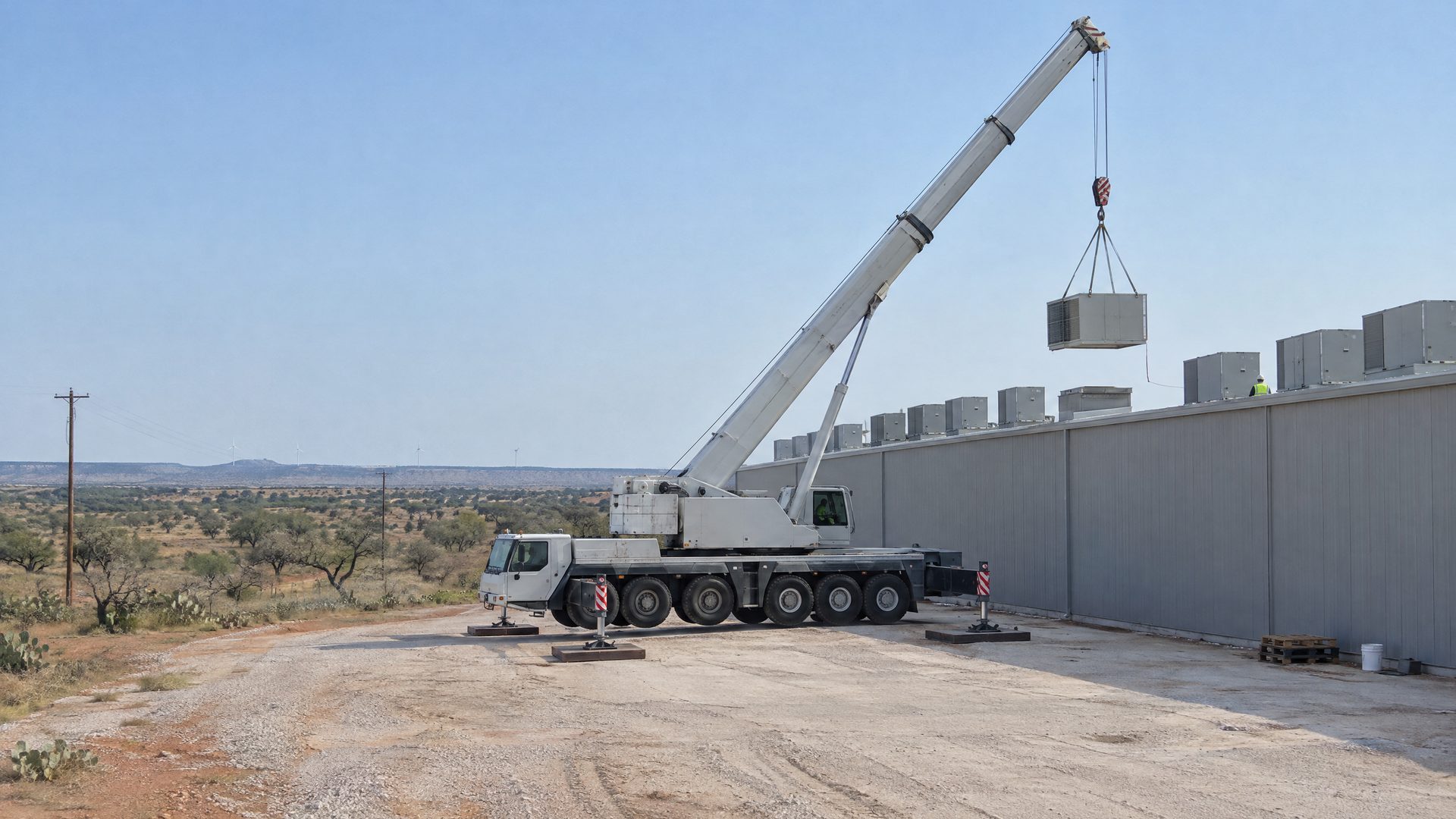
Crane Rental in Albany, TX
Crane rental in Albany, the county seat of Shackelford County, turns on three local questions: how the crane gets up the highway from Abilene, what the ground under it will carry, and how large the job is. The Handbook of Texas puts Albany about 35 miles northeast of Abilene, and the Abilene MPO's 2050 transportation plan, approved December 17, 2024, describes SH 351 as the road between Abilene and US 180 just west of Albany, where traffic connects with US 283. Under the county, the Handbook describes Permian limestone covered by two to fourteen inches of loamy clay topsoil. Jobs run from one rooftop unit to a data-center campus.
Albany had a population of 1,854 in 2020 by the Handbook's table, and the Census Bureau, which counted 3,105 in Shackelford County that year, estimated 3,197 for July 1, 2025. We work out of Abilene, so travel to Albany is priced on every quote. An operated crane arrives with its operator and bills hourly with a minimum charge; a bare crane is the machine only, run by an operator you supply who satisfies OSHA section 1926.1427. Excavators, loaders, lifts and dozers can be booked for one day or for weeks or months at a time. The written quote is free and lists the crane class or machine, travel, permits, mats and each charge with any tax line. National price ranges, with their sources, are on the cost page for cranes and equipment.
every crane and machine is quoted in writing before anything is booked.
Free quote
Frontier, Two Wind Farms and Limestone: The Albany Work Picture
Vantage Data Centers' Frontier campus in Shackelford County is a data-center project measured in gigawatts, described here in its developers' own figures. Vantage's August 2025 announcement planned a 1.4 GW campus on 1,200 acres with 10 data centers totaling 3.7 million square feet, said construction had begun, and set the first building for delivery in the second half of 2026. OpenAI's September 23, 2025 post on new Stargate sites lists Shackelford County among three new Stargate sites being developed by Oracle, joining the flagship Stargate campus in Abilene, and Data Center Dynamics reported on December 15, 2025 that OpenAI and Oracle had been officially tied to the Vantage site that October. W.Media wrote a day later that completion was scheduled for 2028. Our Stargate construction data page dates each figure.
Two wind farms stand in the county. Renewable Energy World reported on January 16, 2009 that the Hackberry Wind Project in Shackelford County consists of 72 Siemens wind turbines with a total capacity of 166 MW, built between January 2008 and December 2008. EDP Renewables North America's Lone Star Wind project page, dated September 2020, gives an installed capacity of 400 MW in two phases across Shackelford and Callahan Counties. Callahan County, with the Mesquite Sky wind farm and TxDOT's I-20 bridge plans, is covered on our Clyde crane rental page. At either farm, the owner controls the site.
Albany's ground is shallow soil over rock. The Handbook of Texas entry on Shackelford County describes surface rock of Permian limestone at altitudes from 1,200 to 2,000 feet under that thin loamy clay, puts the eastern part of the county in the Cross Timbers region, and says the original open prairie is now mostly mesquite and chaparral savanna. That profile cuts both ways: a trench can meet rock a few inches down, and a wet clay skin can give under a crane pad before the rock takes the load. The entry also dates the county's first oil strike to 1910 and records 5,659 barrels a day by 1982. For water, the Handbook lists Albany among the towns Hubbard Creek Reservoir serves, a lake the Texas Water Development Board places about six miles northwest of Breckenridge in Stephens County.
Albany's landmark buildings are old limestone, and two are still in use. The Texas Historical Commission's Shackelford County courthouse page describes a Second Empire courthouse completed in 1884 and rededicated on June 30, 2001, which the county says is restored and still in use. The Old Jail Art Center's original building is a limestone jail built in 1877-1878 by Scottish stonemasons, and the museum says it now covers 17,000 square feet. The ruins of Fort Griffin, established in 1867, lie fifteen miles north on US 283, per the Handbook. Lifts beside buildings like these are planned around the structure and its owner's rules as much as around the load.
See Albany, TX on Google Maps — we quote jobs in this town from Abilene.
Cranes for Albany: Town Lifts, Turbines and a Data-Center Campus
Every crane we send to Albany starts in Abilene. A truck crane or an all-terrain crane makes the trip up SH 351 under its own power; a rough-terrain crane or a crawler is hauled, sometimes under TxDMV permits. After the trip come the ground, thin clay over limestone, and the boom height, which at a turbine can pass the 200-foot line where FAA notice begins.
Truck Cranes for Albany Rooftops, Streets and Lots
A hydraulic truck crane, which carries its telescopic boom on a road-legal carrier, is the usual answer for a one-day lift in Albany, because it covers the drive from Abilene at highway speed and sets up fast. Its kind of pick (one lift of one load) here is a rooftop unit, a sign or a bundle of steel downtown or along US 283 and State Highway 6. Wet loamy clay over limestone can be soft on top, so the outrigger pads (the feet of the crane's extending legs) may need mats. And the City's projects page lists a new sewer line and loop on Chism, Hatcher, Moran and Highway 6 and new fiber-optic lines on streets including South 2nd Street, Refinery Road, Railroad Street and North 1st Street, so find out where those trenches run before a pad goes down. Load charts are on our truck crane rental page.
All-Terrain Cranes for Wind Turbine Work Around Albany
An all-terrain crane, a large telescopic crane that drives the highway on its own axles and steers every wheel on site, is the class to look at when a turbine at the Hackberry or Lone Star wind farm needs heavy work. That job brings three checks. If the tip of the boom will sit more than 200 feet above ground level, the FAA must get notice under 14 CFR 77.9(a), on Form 7460-1, and 14 CFR 77.7 sets that filing at no later than 45 days before the work. Part of the counterweight may travel on separate trucks, and any truck past Texas's legal size or weight needs its own TxDMV permit, plus escorts past set widths, for the run up SH 351. And the farm's owner decides who lifts on the site and when. AT load charts are on our all-terrain crane rental page.
Rough-Terrain Cranes for Albany Leases, Ranches and Raw Sites
A rough-terrain crane, built with four-wheel drive and several steering modes to lift on unpaved ground, fits Albany's off-pavement work: a ranch yard, a building site before its paving, or a lease in a county whose history includes the Cook Field, a prolific shallow oil discovery six miles northwest of town in 1926, per the county. An RT crane's top road speed is low, so it reaches Albany on a lowboy, and a trailer load that breaks Texas's legal envelope (8 feet 6 inches across, 14 feet tall, 80,000 pounds gross) needs a TxDMV permit. Under OSHA section 1926.1402 the crane cannot be set up or run on ground that is not "firm, drained, and graded" to its maker's support and level figures, and the controlling entity (the party in overall charge of the project) must see that the ground is prepared. The RT class is laid out on our rough-terrain crane rental page.
Crawler Cranes for Long, Heavy Programs in the Albany Area
A crawler crane moves on tracks once it is built, but it reaches the job as a convoy of truckloads and goes together on site, so it suits long programs with many heavy picks rather than one lift. In Shackelford County a program of that size is the Frontier campus: Vantage's August 2025 announcement describes ten data centers on 1,200 acres, and Data Center Dynamics reported in December 2025 that they will be single-story buildings, the first due to go live in the second half of 2026. Jobs like those need a crane that stays for months, walks with a load over prepared ground, and spreads its weight through mats or cribbing, the timbers that carry a crane's load into the ground. OSHA sections 1926.1403 and 1926.1404 govern assembly and dismantling. Lattice and telescopic crawlers are compared on our crawler crane rental page.
Boom Trucks for Albany Ranch, Oilfield and Town Deliveries
A boom truck, a telescopic crane on a commercial truck that also hauls the load, fits the Albany jobs where crane and cargo can arrive together: ranch and oilfield equipment, trusses for a house or barn, a sign or a light pole in town. Two checks come first. The truck's rating decides who may drive it: a truck rated at 26,001 pounds or more falls in the FMCSA's Class B, which takes a commercial license. And on a ranch or lease road the outriggers need firm, level footing like any crane's, which on clay over limestone can mean mats under each pad. Model charts are on our boom truck rental page.
Carry Deck Cranes for Tight and Indoor Albany Lifts
Carry deck cranes are small rubber-tired cranes with three ways to handle a load: from outriggers, on the hook while driving (pick-and-carry), or riding on the machine's own flat deck, so they work indoors or wherever a truck crane has no room to spread its legs. We found no factory listed on Albany's town or county pages, so a carry deck job here is defined by the doorway and the floor. Large single-story buildings like the ten Vantage plans at Frontier, with the liquid cooling and closed-loop chiller system its August 2025 announcement describes, are the kind of interior where moving mechanical gear over a finished slab is pick-and-carry work. The three ratings differ for one machine; they are set out on our carry deck crane rental page.
Lift Plans for Albany's Historic Stone and Turbine Picks
A lift plan puts in writing the load's weight, the rigging, the signals and the landing spot, and two Albany jobs make it central: a lift beside historic limestone and a heavy turbine pick. Beside the 1884 courthouse or the 1877-1878 jail, it fixes where the crane stands, the radius (how far out, measured level, the load hangs from the crane's turning axis) and a swing zone that OSHA section 1926.1424 requires to be marked off with control lines, warning lines, railings or similar barriers. At a turbine it adds a wind limit: Liebherr writes that "The lifting capacity tables for cranes generally apply in gust speeds of up to 9 m / s (20 mph)", and Manitowoc's 2250 Series 2 chart says wind is read at boom point elevation. NOAA's 1984-2024 annual summaries for Abilene's airport station top out at a 74.0 mph gust on June 21, 2023. See our rigging and lift planning page.
Heavy Haul to Albany on SH 351, US 180 and US 283
Heavy haul means moving a load that exceeds what a standard truck may legally carry, and any Albany job that needs a crawler crane, a dozer or a large plant machine starts with its route. The Abilene MPO's plan gives the main road: SH 351, running from Abilene to US 180 just west of Albany, where traffic joins US 283. Data Center Dynamics, citing local news on July 28, 2025, placed Vantage's proposal at the intersection of Highway 604 and Highway 351. Beyond the legal limits, TxDMV's general single-trip permit covers loads up to 254,300 pounds, and its superheavy permit, which TxDMV says to seek three to four weeks ahead, covers more. TxDMV also says "Vehicles and loads exceeding 14 feet wide, 16 feet high, or 110 feet long may not be moved" on the holidays it lists unless it grants an exception. For escorts and flags, see heavy haul and machinery moving.
Equipment Rental in Albany, From Utility Trenches to Data Halls
Albany's equipment work follows three facts: utility trenches in town streets, a very large construction site in the county, and thin clay over limestone. Each machine comes with the maker's operating information. Before a bucket breaks ground, Texas 811 says "Texas law requires excavators to contact 811 at least two business days before excavating", and we or you make that call as the law sets out.
Excavators for Albany Sewer, Water and Fiber Trenches
An excavator digs the trenches Albany's utility work calls for, and the City's projects page shows where: a new sewer line and loop on Chism, Hatcher, Moran and Highway 6 by contractors working on behalf of the State, and fiber-optic crews on several other streets. New lines there make the locate call count, and Texas 811's FAQ cites industry practice to "set 18 inches on either side of the marked utility as a reasonable tolerance zone." Albany's rock bears on OSHA's trench rule too: 29 CFR 1926.652 waives a protective system only for a dig made entirely in stable rock, or one shallower than 5 feet in which a competent person, someone "capable of identifying existing and predictable hazards", sees no sign of a cave-in. A trench cut through loamy clay into limestone is not entirely in rock. Sizes and dig depths are on our excavator rental page.
Skid Steers and Track Loaders on Albany's Clay and Brush
A skid steer steers like a tank, slowing the wheels on one side to turn, and a compact track loader does the same on rubber tracks; near Albany the deciding question is the clay after a rain. On the loamy clay topsoil the Handbook describes, tracks spread the weight and keep working on a wet surface, while wheels suit a dry yard, a slab or a gravel pad. Ranch ground across the county is mesquite and chaparral savanna in the Handbook's words, which favors a loader built for unpaved work. OSHA's rollover subpart, section 1926.1000, reaches rubber-tired skid-steer machines "manufactured after July 15, 2019, that are used in construction work", and section 1926.602 calls for seat belts on earthmoving equipment. For capacities and ground pressures by model, open skid steer and track loader rental.
Telehandlers for Albany Ranch Buildings and Campus Materials
Telehandlers are reach forklifts whose boom telescopes, so they set pallets, framing and roofing up and out where a straight-mast truck cannot: ranch buildings around Albany, or materials for single-story buildings like the ten Vantage describes at Frontier. OSHA's eTool files the type under Class VII as variable reach, and its training rule, section 1910.178(l), says "An evaluation of each powered industrial truck operator's performance shall be conducted at least once every three years." Hang a hook or winch on the boom and the rules change: OSHA's Cranes FAQ says "Equipment that is designed to function as both a crane and a forklift would be considered multi-purpose equipment", and its June 21, 2012 letter places such a machine under the crane standard once it is set up and run as a crane. Ratings at full height and reach are on our telehandler rental page.
Boom Lifts for Albany's Limestone Walls and Rooftops
A boom lift carries workers in a basket at the end of an arm, and it is how crews reach the walls and roofs of Albany's old limestone buildings, such as the 1884 courthouse and the 1877-1878 jail that houses the Old Jail Art Center. An articulating boom bends over a cornice; a telescopic boom reaches farther in a line. Under OSHA section 1926.453 the controls get a test every day before use and the worker in the basket wears a lanyard, and the agency's fact sheet on aerial lifts says "Use a body harness or a restraining belt with a lanyard attached to the boom or bucket." The same sheet says "Treat all overhead power lines and communication cables as energized, and stay at least 10 feet (3 meters) away." Heights and outreach are on our boom lift rental page.
Scissor Lifts Inside Albany's Galleries and Data Halls
Scissor lifts climb straight up on folding cross-braces with a railed platform on top, and in Albany they suit flat floors indoors: the gallery, education, archive and storage rooms of the Old Jail Art Center, or the inside of large single-story buildings like those planned at Frontier. In a letter dated August 1, 2000, OSHA classed them as scaffolds rather than aerial lifts, which brings in the scaffold standard's mobile-scaffold paragraph, 1926.452(w), and with sound guardrails no tie-off is required. Outdoors, OSHA's scaffolding eTool warns that "Scissor lifts rated for outdoor use are generally limited to wind speeds below 28 miles per hour." NWS San Angelo logged 10 days in March 2025 when Abilene's peak daily gust reached 40 mph or more. Slab and rough-terrain models are compared on our scissor lift rental page.
Forklifts for Albany Laydown Yards and Job Sites
A forklift raises loads on an upright mast, and in Albany the forklift question is mostly about the ground outside, since we found no warehouse or factory on the town's or county's pages: pipe, cable reels and pallets at a laydown yard for utility or building work. On gravel or clay the truck needs pneumatic tires or a rough-terrain design, which OSHA's powered industrial truck eTool places in Class VII for unimproved natural terrain, while warning that rough terrain does not mean every terrain. On a finished slab, a cushion-tire truck fits. OSHA's section 1910.178(l) wants the training and evaluation done by people with "the knowledge, training, and experience" to train and judge operators, and we ask that renters' operators be trained under that rule. Capacities and masts are on our forklift rental page.
Backhoes and Loaders for Albany Taps, Lines and Lease Roads
A backhoe loader is a tractor-sized machine with a loader at one end and a backhoe arm at the other, the one-machine way to dig, lay and backfill a short service line in Albany. The City's posted ordinances include one on water connections, which is worth reading before a new tap. Where the Handbook's limestone lies under only inches of topsoil, a backhoe meets rock early, which slows the trench and can call for an excavator instead. A wheel loader is the other half of this rental: it loads trucks, moves base and keeps a lease or ranch road graded. Every dig starts with the Texas 811 call, and OSHA's spoil rule in section 1926.651 sets a 2-foot setback from the trench lip. Dig depths and bucket sizes by model sit on the backhoe and loader rental page.
Dozers for Albany Pads, Lease Roads and Mesquite Ground
A dozer, a crawler tractor that cuts and pushes earth with a front blade, does the first earthwork on a big site, and in Shackelford County a large one is Vantage's Frontier campus, where ten single-story data centers each need a level pad. Dozers also open and keep up lease roads, and on mesquite and chaparral savanna the brush comes off before the grade goes in. Thin topsoil over limestone limits how deep a blade cuts before it meets rock. Crawler tractors on construction work fall within OSHA's rollover-protection subpart, section 1926.1000; section 1926.602 adds seat belts and a backup alarm or a signaler where the operator cannot see behind the machine; and a Texas 811 ticket comes before any grading that could reach a buried line. Blade sizes and weights are on our dozer rental page.
Permits, Roads, Lines and Airspace for an Albany Lift
The City of Albany posts few rules online, so a crane or machine headed for an Albany street starts with City Hall. When we checked, the City's Code of Ordinances page posted four ordinances, on weeds and vegetation, food trucks, water connections and RVs, and no building-permit, street-cut, right-of-way or truck-route rule. City Hall is at 425 South 2nd Street, open 8 a.m. to noon and 1 p.m. to 5 p.m. Monday through Thursday and 8 a.m. to 4 p.m. on Fridays. Shackelford County's site lists the courthouse at 225 South Main Street and has no road-and-bridge or permit page.
State and federal rules apply in Albany as anywhere in Texas. Under Texas Health and Safety Code chapter 752, no one may work where a person or machine could come within six feet of a high voltage line until the responsible party notifies "the operator of the line at least 48 hours before the work begins" and a safeguard is in place; OSHA section 1926.1408 makes 20 feet the default gap for crane work by lines of 350 kV or less. The Handbook lists one airport in the county in 1984, the Taylor Airport in Albany; we could not confirm its runway length, which decides whether the 100-to-1 surface out to 20,000 feet or the 50-to-1 surface out to 10,000 feet in 14 CFR 77.9(b) applies to a tall boom nearby. See our guide to crane permits, airspace and line clearances.
- Texas 811's FAQ: locators get 48 hours, holidays not counted, and a dig that starts more than fourteen days after the notice needs a new one.
- A crane built too wide or heavy for Texas's limits can run a full year on one TxDMV Unladen Lift Equipment permit: $100, a 10-foot width cap and a 120,000-pound gross cap.
- TxDOT's Abilene District projects page listed two current projects, one in Tuscola and one in Abilene, and none in Shackelford County.
- OSHA, 29 CFR 1926.1417(h): "When a local storm warning has been issued, the competent person must determine whether it is necessary" to secure the crane the way its maker recommends.
Albany FAQs
Do you bring cranes to Albany from Abilene?
Yes. The Handbook of Texas puts Albany about 35 miles northeast of Abilene, and SH 351 links the two. A truck crane or an AT crane covers that road on its own wheels; a rough-terrain crane, a crawler or a large machine comes on a trailer with whatever TxDMV permit and escorts the load needs, and the quote prices the trip separately.
What cranes does a data center campus like Frontier need?
Several classes over a long build. Vantage's August 2025 announcement describes ten data centers totaling 3.7 million square feet on 1,200 acres; work of that size calls for crawler or all-terrain cranes for heavy picks, rough-terrain cranes on unpaved ground, carry deck cranes and forklifts indoors, and aerial lifts overhead. The campus owner and its contractors decide who works on the site and under what rules.
Does the City of Albany require a street permit for a crane?
No such rule is posted, so ask the City before the date is set. When we checked, the City of Albany's ordinance page showed four ordinances, none on street use, street cuts or truck routes, which makes City Hall on South 2nd Street the place to ask. Whatever the City requires goes on the written quote with any barricades or traffic control.
How close can a crane work to power lines in Albany?
Six feet under Texas law and 20 feet under OSHA, with ways to work closer. Texas's chapter 752 bars bringing "any part of a tool, equipment, machine, or material within six feet of a high voltage overhead line" unless the line's operator has 48 hours' warning and a safeguard is in place, at the expense of whoever does the work. OSHA's 20 feet covers lines of 350 kV or less unless the voltage table is used. Ahead of the lift we check the set-up against both and tell you who has to call the utility.
Get Your Free Albany Quote
Free quote