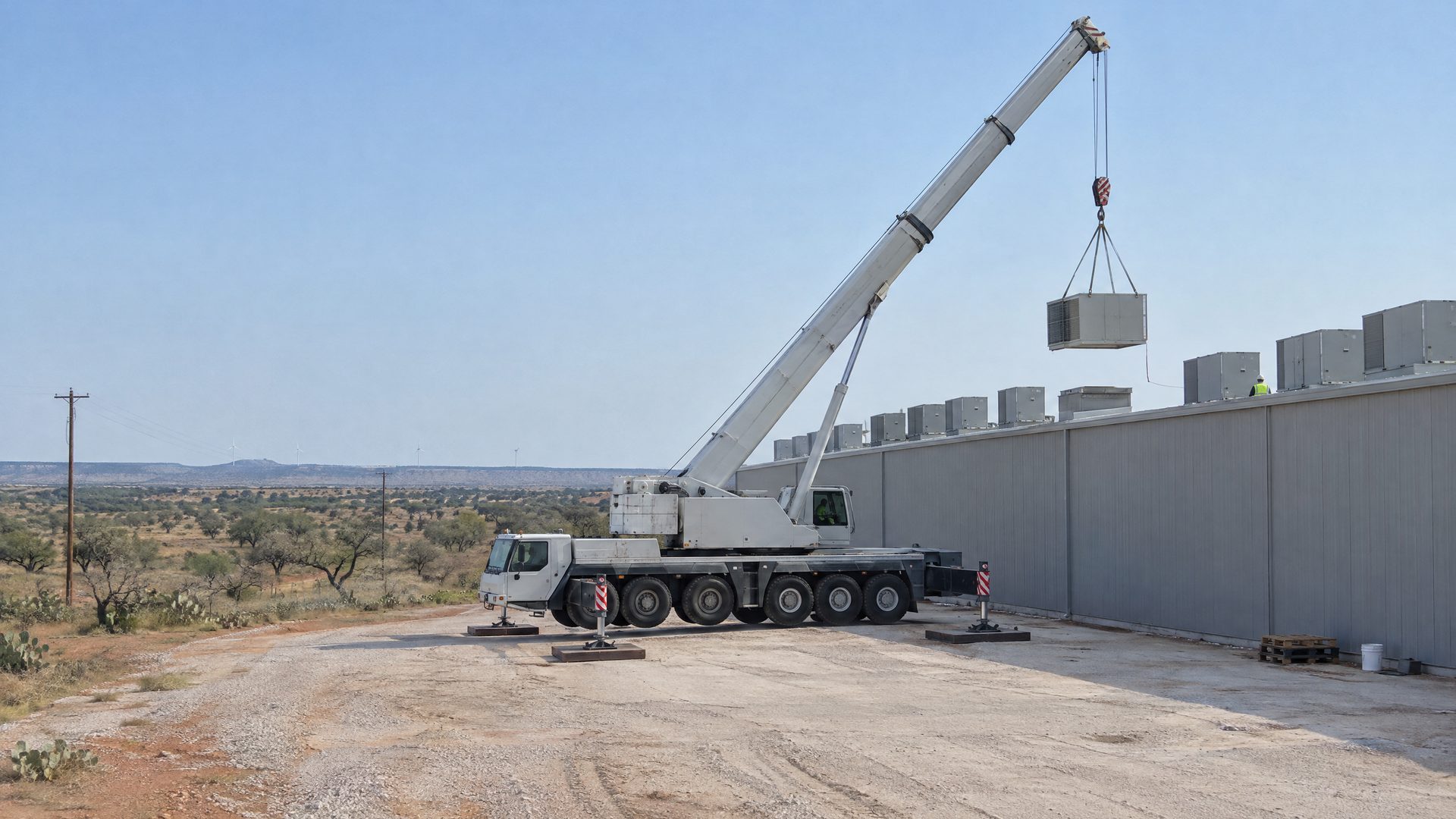
Crane Rental in Snyder, TX
We supply cranes and heavy equipment for Snyder and the rest of Scurry County, from oil-field pads and wind farms to rail-park buildings and the courthouse square. The Handbook of Texas places Snyder, the county seat, at the junction of U.S. highways 84 and 180, and the Development Corporation of Snyder (DCOS) says Lubbock, Abilene and Midland-Odessa all lie within 90 miles. Oil came with the 1948 Canyon Reef discovery north of town (Handbook), and carbon dioxide injection at the SACROC unit near Snyder dates from 1972 (Energy Department). The Census Bureau counted 11,438 in Snyder in 2020 and estimates 11,166 for July 1, 2025.
Every crane on a Snyder job is either operated or bare. An operated rental brings the crane with its operator, billed hourly against a minimum; a bare rental is the machine alone, and your operator must satisfy OSHA section 1926.1427, under which operators are "trained, certified/licensed, and evaluated," so we will ask who that is. Send the load's weight and size, the pick point and set point, the ground, any power lines, the address and the dates. The quote comes back in writing, free of charge, each cost and any tax on its own line, and the pricing page gathers national ranges with dates and sources.
every crane and machine is quoted in writing before anything is booked.
Free quote
Oil, Carbon Dioxide, Wind and Rail: Where Snyder's Work Comes From
Oil remade Snyder. The Handbook of Texas says the town "remained a farming and ranching community until 1948, when oil was discovered on the Canyon Reef formation north" of town, after which its population went from around 4,000 to over 12,000 within a year. In the late 1960s Scurry County out-produced every other Texas county, the Handbook says, and in 1973 Scurry oil companies recovered their billionth barrel. Canyon Reef wells were drilled to 6,500 feet; the county produced almost 94,173,000 barrels in 1974, and by January 1, 1991, 1,825,517,000 barrels had come out of Scurry County land. A field that size means wellheads, tanks, pumping units, pipe and compressors to set, swap and haul.
Carbon dioxide keeps the field producing. The Handbook credits "a locally developed method of injecting carbon dioxide into the formation to increase the pressure," and a National Energy Technology Laboratory fact sheet on SACROC puts the unit "Near Snyder, Texas," in central Scurry County, names Kinder Morgan CO2 Company as operator, counts "more than 55 MtCO2" injected and gives the reservoir depth as ~6300-7100 ft. DCOS calls the Scurry Area Canyon Reef Operators unit "one of the largest, oldest and most productive oil fields in the nation." Injection and production plants of that kind run on compressors, vessels and pipe that cranes set and heavy machines service.
Wind is the county's second energy business. DCOS says one wind farm, which it calls the fourth largest in the U.S., "deploys more than 100 wind turbines in Scurry County" and can produce "more than one million megawatt hours of wind energy annually." A Texas Comptroller release of October 12, 2023 says RWE's Roscoe Wind Complex has farms "in Nolan, Mitchell, Fisher and Scurry counties," and the Comptroller's 2023 wind table rates the complex at 782 MW; its Nolan County side is on our Sweetwater crane page. Turbines on open prairie mean long booms, heavy components and unpaved access roads.
Rail and industrial land line the highways. The Handbook says construction began on the Roscoe, Snyder and Pacific Railway in 1907 and the Santa Fe laid track through Snyder in 1911, and its Nolan County entry says the Roscoe, Snyder and Pacific "now runs only from Roscoe to Snyder." DCOS markets the Snyder Rail Park, thirty-four continuous acres on Business Highway 84 with BNSF connections, power from Big Country Electric Co-op and City of Snyder water, and an eighty-acre Snyder Industrial Park at Highways 180 and 84 (DCOS industrial parks page). A Texas A&M Transportation Institute aviation page reports a new plastics plant in Snyder, and the Handbook names cotton as the county's most important crop.
Public buildings bring interior and rooftop work. Cogdell Memorial Hospital, a "Critical Access Hospital and a Rural Health Clinic," says it has served Scurry County and surrounding communities from 1954, and the hospital's About page lists completed projects including a Family Medicine Clinic, a Rehabilitation and Wellness Center, a Laboratory, Day Surgery Suites and an Obstetrics Wing. Western Texas College, which the Handbook says opened with 649 students, lists Electrical Lineworker, Welding, Petroleum Technology, Data Center Technician and CDL programs.
See Snyder, TX on Google Maps — we quote jobs in this town from Abilene.
Crane Classes for Snyder's Oil Field, Wind Farms and Town Jobs
Which crane a Snyder job needs comes down to the load, how far out it hangs and what the crane stands on. The load chart, the table a manufacturer prints for each crane, gives the rated load for every pairing of boom length and radius, the radius being the level distance between the crane's turning center and the hanging load, and Manitowoc's chart notes put it outright: "In all cases, operating radius shall govern capacity." Outrigger pads, the feet at the ends of the beams a crane extends to level itself, sit on what the Handbook of Texas calls "light to dark loam surface soils with reddish, clayey subsoils," so pads, cribbing (timber blocks stacked under a pad) or crane mats go into the plan.
Truck Cranes for Snyder's Courthouse Square, Clinics and Shops
For a one-day lift in town, a hydraulic truck crane is the first class to price: a telescoping crane on its own highway carrier that drives in on U.S. 84 or 180, sets its outriggers and makes its picks, the trade's term for single lifts: rooftop units, shop steel and trusses, or a highway sign. Downtown, the street under the crane may be a state highway. For TxDOT's overlay of US 180 "from the intersection of US 180 and SH 350 at the Snyder Courthouse east to US 84," the City of Snyder warned on March 28, 2025 of "a lane closure on US 180 that will affect parking around the Snyder Courthouse square," so a set-up on the square needs a lane and traffic plan. See the mobile crane rental page.
All-Terrain Cranes for Wind Turbine Lifts Near Snyder
When the lift is at a Scurry County wind farm, an all-terrain crane is the class to compare first: it covers highway miles at road speed, then works the turbine access road on a carrier that drives and steers on several axles. Tall towers bring two rules. FAA notice under 14 CFR 77.9(a) begins with "Any construction or alteration that is more than 200 ft. AGL at its site," anywhere in the county, and OSHA section 1926.1417(n) has the competent person, in OSHA's definition a person who can recognize existing and predictable hazards and may act at once to remove them, adjust "the equipment and/or operations to address the effect of wind, ice, and snow." On open prairie the crane maker's wind limits decide which days work. Compare classes on the all-terrain crane rental page.
Rough-Terrain Cranes for SACROC Leases and Snyder Oil Pads
Out on the leases, the rough-terrain crane is the class built for oil-field pads: large off-road tires, steering modes for tight spots and a slow top speed, so it rides a trailer to Snyder and then drives the lease roads itself. Setting and changing pumping units, tanks, pipe and compressor skids in the SACROC unit and other Scurry County leases are jobs for it. OSHA section 1926.1402 requires ground "firm, drained, and graded" enough for the maker's support and level specifications, while section 1926.1402(c)(2) makes the controlling entity "Inform the user of the equipment and the operator of the location of hazards beneath the equipment set-up area" that site documents show, so bring the lease's pipeline drawings. See the rough-terrain crane rental page.
Crawler Cranes for Rare Long, Heavy Jobs Around Snyder
Our sources list no Snyder project of the long, heavy kind that crawler cranes are brought in for, so here the class is an exception: it fits weeks of heavy lifts at a plant or energy site, on ground that can be graded and matted, where the work repays trucking the crane in pieces under TxDMV permits and assembling it on site. OSHA section 1926.1404 puts assembly and disassembly under a director who "meets the criteria for both a competent person" and a qualified person, or a competent person backed by qualified persons. The crawler crane rental page weighs crawlers against all-terrain cranes.
Boom Trucks for Snyder Oilfield Yards, Ranches and Shops
A boom truck, a truck that carries its own telescoping crane along with the cargo, fits the spread-out lifts around Snyder: pipe and small tanks to a lease, ranch and oilfield equipment, trusses or steel to a shop, and signs or light poles on U.S. 84 and 180. Western Texas College lists a CDL program, and the license matters on a bare rental, because the FMCSA's Class B reaches "Any single vehicle which has a gross vehicle weight rating or gross vehicle weight of 11,794 or more kilograms (26,001 pounds or more)." OSHA counts "boom truck cranes" among cranes in section 1926.1400, which brings its power line rules to every pick near a line. See the boom truck rental page.
Carry Deck Cranes for Snyder Plants and Rail Park Buildings
Inside a building, a carry deck crane goes where a truck crane cannot: this compact, wheeled industrial crane lifts on outriggers, travels with the load hanging (pick and carry) or carries parts on its own deck. In Snyder that means the plastics plant a Texas A&M Transportation Institute page mentions, buildings in the Snyder Industrial Park and the Rail Park, and oil-field service bays where pumps, motors and valves move between benches. The maker's chart rates pick and carry below an outrigger lift, and OSHA's 29 CFR 1926.1417(u) says "Traveling with a load is prohibited if the practice is prohibited by the manufacturer." See the carry deck crane rental page.
Rigging and Lift Plans for Snyder Oil-Field and Wind Picks
Rigging is the gear and method that hang the load from the hook, and a lift plan is the written sequence tying the load's weight, the rigging's weight, the crane, radius, ground and signals together; ASME's page for P30.1 says "The categories are designated as Standard Lift Plan and Critical Lift Plan." OSHA section 1926.1417(o) says "The equipment must not be operated in excess of its rated capacity," with the load's weight taken "from a source recognized by the industry" or an equally reliable method. On a lease, power lines may cross a pad, so the planning meeting in 29 CFR 1926.1408(b) reviews where they run, and under section 1926.1431, wind that "exceeds 20 mph at the personnel platform" hands the go or no-go on lifting workers to a qualified person. See rigging and lift planning.
Heavy Haul to Snyder on U.S. 84, U.S. 180 and SH 208
Machines too big for a normal trailer reach Snyder by heavy haul, and the roads make the plan. DCOS says U.S. 84 at Snyder "connects to I-20 less than 20 miles away," TxDOT's project page places the I-20 and US 84 interchange at Roscoe in Nolan County, and the Handbook has U.S. 84 crossing Scurry County from northwest to southeast, with State Highway 208 running north to south. In town, a TDLR filing shows TxDOT replacing the FM 1673 (Avenue E) bridge at US 84, with completion listed as 5/14/2025. For oil-field moves, TxDMV says "An oil well related vehicle or unladen lift equipment motor vehicle exceeding 175,000 pounds gross weight must have front and rear escorts when crossing bridges." Permits and escorts in full: heavy haul and machinery moving.
Equipment Rental for Snyder Leases, Lots and Buildings
A Snyder rental runs as long as the job, by the day, week or month, and the maker's operating information travels with the machine. Tell us which machine, the work it faces, the ground and the rental period. Someone calls 811 before the first bucket or blade goes in, inside the window Texas811 cites from the law, "no more than fourteen days nor no less than forty-eight hours before the excavation is expected to commence," and that someone is us or you. We ask each renter to confirm that the people driving forklifts and telehandlers or working from boom and scissor lifts have had the training OSHA's rules and the ANSI/SAIA standards call for.
Excavators for Snyder Pipelines, Footings and Service Lines
In Snyder an excavator digs footings and service lines in town and trenches near oil-field pipe, and the buried pipe comes first. Texas811 defines a pipeline's tolerance zone as "a minimum of 18 inches on either side of the outside edge of the underground pipeline on a horizontal plane," and its rule for a strike is blunt: "If a gas line has been hit or damaged, you must also call 911." OSHA section 1926.651 wants utility locations "determined prior to opening an excavation," and 29 CFR 1926.652 calls for cave-in protection except in stable rock or a cut "less than 5 feet (1.52m) in depth" that a competent person judges sound. A mini excavator suits a town lot, a full-size one pipeline and pad work. See the excavator rental page.
Skid Steers and Track Loaders for Snyder Pads and Brush
Small earthwork on a Snyder job, from leveling a pad and spreading base to backfilling and cleaning up a lease or lot, goes to a skid steer or a compact track loader. Tracks put the machine's weight over more ground and suit soft or loose soil; wheels run faster on pavement. The Handbook describes Scurry County as prairie "with mesquite trees in some sections," so brush along fences and pads may need clearing too. OSHA section 1926.1000 brings "rubber-tired skid-steer equipment" built after July 15, 2019 under its rollover rules when used in construction, and section 1926.602 requires seat belts. Makers' rated operating capacities, model by model, are on the skid steer and track loader page.
Telehandlers for Snyder Industrial Park and Campus Work
A telehandler sets pallets, block, trusses and roofing on upper levels from rough ground, which fits buildings in the Snyder Industrial Park or the Rail Park, college and hospital work, and material handling in oil-field supply yards. OSHA's powered industrial truck eTool describes the type as one "equipped with a telescoping boom, which enables it to pick and place loads at various distances." OSHA's forklift training rule, section 1910.178(l), reaches construction through section 1926.602(d): training first, then a performance evaluation "at least once every three years." Hanging loads from it can make it a crane in OSHA's eyes, "when configured, and operated as, a crane." See the telehandler rental page.
Boom Lifts for Snyder Storefronts, Signs and Plant Work
A boom lift puts a worker in a basket on a telescopic boom, for long straight reach, or an articulating boom that bends over obstacles. Around Snyder it reaches storefronts and signs on the courthouse square and along the highways, rail park and plant buildings, and lighting or pipe racks at oil-field facilities. Under OSHA section 1926.453, "Only authorized persons shall operate an aerial lift"; the agency's fact sheet asks for "a body harness or a restraining belt with a lanyard attached to the boom or bucket" and says "Do not operate an aerial lift in high winds above those recommended by the manufacturer." Closer than six feet to a high-voltage line, Texas chapter 752 needs the line's operator told and a safeguard arranged first. Training follows ANSI/SAIA A92.24. See the boom lift rental page.
Scissor Lifts for Snyder Hospital, College and Shop Interiors
Interior work over a flat floor, such as ceilings, lights, sprinkler lines and ducts, is scissor lift work, with slab electric models indoors and rough-terrain models outside. In Snyder the hospital is the clearest case: Cogdell Memorial Hospital lists Day Surgery Suites, an Obstetrics Wing and a Laboratory among its completed projects, and spaces like those, plus Western Texas College classrooms and warehouse floors in the industrial parks, are where a scissor lift earns its keep. OSHA's August 1, 2000 letter says scissor lifts "do meet the definition of a scaffold," so guardrails give the fall protection, and its scaffolding eTool says "Scissor lifts must have guardrails installed to prevent workers from falling." See the scissor lift rental page.
Forklifts for the Snyder Rail Park, Plants and Supply Yards
Floors choose the forklift: cushion tires on concrete inside, pneumatic tires on yards and docks, and for unimproved ground the type OSHA's eTool heads "Class VII: Rough terrain forklift trucks." Forklift settings in Snyder include the Rail Park, where DCOS lists BNSF connections, the plastics plant, the industrial park at Highways 180 and 84 and oil-field supply yards. OSHA section 1910.178(l) has each operator finish training and an evaluation before driving, and section 1926.602(c) says lift trucks "shall have the rated capacity clearly posted on the vehicle." The forklift rental page compares mast heights and capacities.
Backhoes and Wheel Loaders for Snyder Utility and Lease Work
A backhoe loader handles small utility jobs alone, digging a service line or culvert with the rear arm, backfilling with the front bucket and driving between Snyder sites; a wheel loader loads trucks and moves base and stockpiles on pads, lease roads and yards. Any tie-in to the City of Snyder's water, which DCOS lists at the Rail Park, follows City rules we could not read online. OSHA section 1926.602 covers both machines, with "Seat belts shall be provided on all equipment covered by this section," and its section 1926.1000 rollover rules list "rubber-tired front-end loaders." Each trench is an excavation under OSHA's Subpart P, and the 811 request comes before the first cut. Dig depths are on the backhoe and loader rental page.
Dozers for Snyder Well Pads, Lease Roads and Mesquite
A dozer builds and repairs what the oil field and the wind farms run on: well and equipment pads, lease and turbine roads, and berms, and on ranch land it clears the mesquite the Handbook notes in parts of the county. Scurry County "is at the base of the Llano Estacado," the Handbook says, with elevations from 2,000 to 2,700 feet and the Colorado River cutting across its southwestern corner. Grading where pipelines may lie starts with an 811 locate, and Texas811 reminds diggers that "the excavator is responsible for knowing the condition of the excavation site." OSHA's rollover rules in section 1926.1000 name "crawler tractors," and section 1926.602 requires seat belts. See the dozer rental page.
Permits, Highways, Airspace and Lines for Snyder Jobs
The City of Snyder's own rules are the gap. Its websites and its code on eCode360 refused to load when we checked, so this page states no City of Snyder permit, street, parking or truck rule; phone the City before you set a crane or machine on a Snyder street, and treat Abilene's rules as Abilene's only. What the City did publish shows how downtown work runs: its March 28, 2025 alert said TxDOT's hot mix overlay of US 180 would start the first week of April and take about four weeks, weather permitting. US 84, US 180 and SH 208 are state highways in TxDOT's Abilene District, which includes Scurry County.
Winston Field is the airport to plan around. The Texas A&M Transportation Institute lists Runway 17/35 at 5,599 feet by 100 feet and Runway 8/26 at 4,200 feet by 75 feet, and the FAA's RNAV (GPS) RWY 35 chart for Winston Field shows a field elevation of 2430. An airport with an FAA instrument approach falls under 14 CFR 77.9(d), and one "with its longest runway more than 3,200 ft." carries the 100-to-1 notice surface that runs 20,000 feet out; add the general 200-foot trigger, and any tall crane near the field needs checking. Form 7460-1 must go in "at least 45 days before the start date of the proposed construction," and we check a Snyder lift near the field against these criteria and tell you whether to file.
Lines and wind close out the checklist. OSHA section 1926.1408 starts with whether the crane, load line or load "could get closer than 20 feet to a power line," and the Texas statute, Health and Safety Code chapter 752, forbids bringing "any part of a tool, equipment, machine, or material within six feet of a high voltage overhead line" until the line's operator has 48 hours' notice and a safeguard is agreed. Know whose line it is: DCOS lists Big Country Electric Co-op as the provider at the Snyder Rail Park. Our sources hold no Snyder wind record, and the gusts on our weather and construction data page were measured in Abilene, so work halts when the operator or the competent person decides wind has made it unsafe, as OSHA section 1926.1417 and the maker require.
- TxDMV escort table: "Exceeding 14' to 16'" in width calls for "1 Front - two-lane highway" or "1 Rear - multi-lane highway," and "Exceeding 16'" calls for "1 Front and 1 Rear - all roads."
- TxDMV Superheavy permits cover loads that "exceed 254,300 pounds total gross weight," and TxDMV says to apply "three to four weeks before the permit is needed."
- TxDMV's mileage-based single-trip permit for unladen lift equipment and well-servicing units is valid for a maximum of seven consecutive days, with a minimum fee of $31.
- The crane permit, airspace and power line guide covers each of these rules in more depth.
Snyder FAQs
Do you bring cranes to Snyder from Abilene?
Yes. DCOS puts Abilene within 90 miles of Snyder and says U.S. 84 at Snyder connects to I-20 less than 20 miles from town, so a truck crane or boom truck drives up, and a rough-terrain crane or large machine arrives on a trailer under any TxDMV permit it needs. The written quote prices travel and delivery as separate items, next to the minimum hours or rental term. Tell us the load, the lift height and radius, the ground, any overhead lines and the dates.
Can a crane work at a wind farm near Snyder?
Yes, with the farm owner's permission and a lift plan built for height and wind. The Scurry County farms include the one DCOS says has more than 100 wind turbines and part of RWE's Roscoe Wind Complex, and each owner controls site access and contractor requirements, which we do not speak for. What we control is the plan: whether the boom tops 200 feet above ground and needs FAA notice, what wind the crane's manual allows, how the competent person will handle gusts under OSHA section 1926.1417(n), and whether the turbine pad will hold the outriggers.
Can a rough-terrain crane work on an oil lease near Snyder?
Yes. Rough-terrain cranes are built for unpaved lease pads and come to Snyder by trailer. The lease's controlling entity must provide ground that is "firm, drained, and graded" under OSHA section 1926.1402 and tell the crane user about known voids, tanks or utilities under the set-up area. Pipelines are the other hazard, so the Texas811 ticket comes two business days ahead of any digging, and power lines on the pad bring OSHA's 20-foot check and the Texas six-foot rule. The lease operator sets its own access rules.
Who do I notify about power lines before a crane job in Snyder?
Notify the operator of the line. Texas Health and Safety Code chapter 752 requires that notice at least 48 hours before work that could bring equipment within six feet of a high-voltage line, and at the Snyder Rail Park DCOS lists Big Country Electric Co-op as the electric provider. If you ask a utility for a line's voltage, OSHA section 1926.1408 gives it two working days to answer. We check the site against both rules before the lift and spell out who arranges what.
Get Your Free Snyder Quote
Free quote