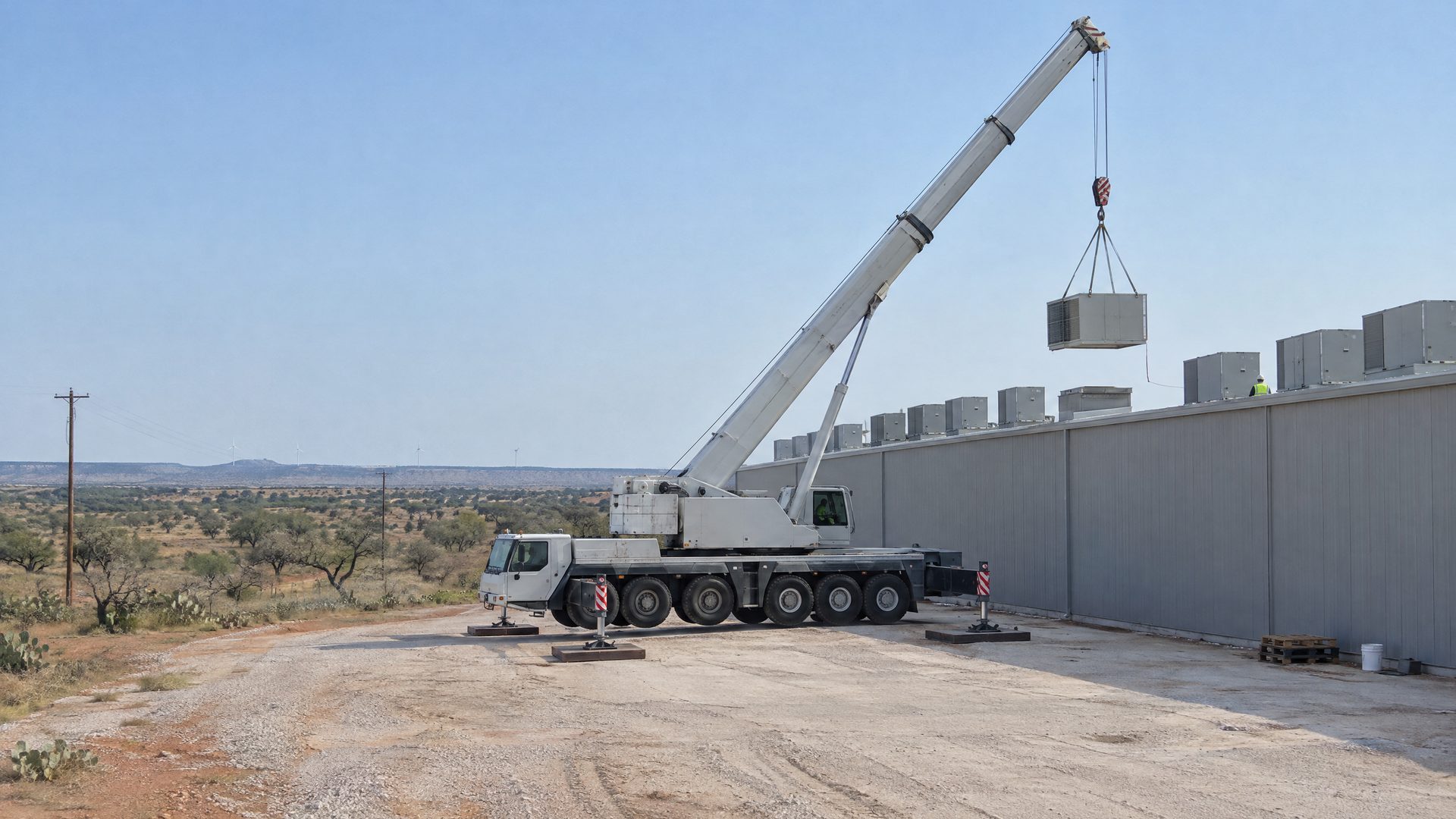
Crane Rental in Sweetwater, TX
We bring cranes and heavy equipment to Sweetwater, the Nolan County seat the Handbook of Texas places forty-two miles west of Abilene, and the right machine for a job here depends on what the town makes and builds: gypsum wallboard and sheetrock beside town, cement at Maryneal to the south, wind power across the county and, outside town, a data-center campus whose first site IREN has energized. Sweetwater's 2020 Census count was 10,622, and the Census Bureau's estimate for July 1, 2025 is 10,141. Below, every crane service and rental machine gets its own Sweetwater section, and the last section sets out the rules for lifting or digging here.
Cranes come operated or bare. Operated means the crane arrives with an operator and bills by the hour against a minimum, and OSHA section 1926.1427 governs that operator: "The employer must ensure that each operator is trained, certified/licensed, and evaluated in accordance with this section." Bare means the crane alone, so whoever runs it must meet that rule, and we ask who that is. To quote, we need the load's weight, where it sits and where it goes, the ground, any wires overhead, the address and your dates. You get that quote in writing at no cost, each charge and any tax broken out, and our cost page collects the national price ranges, dated and sourced.
every crane and machine is quoted in writing before anything is booked.
Free quote
Gypsum, Cement, Wind and Data Centers Around Sweetwater
Gypsum is a major Nolan County industry. The Handbook of Texas says United States Gypsum began operating near Sweetwater in 1924, and Sweetwater Economic Development's manufacturing page says USG's sheetrock site has a line that "can run over 450' per minute." The same page says Georgia-Pacific makes wallboard in "specialty sizes and thicknesses" in Sweetwater, and a Georgia-Pacific release dated Oct. 5, 2023 describes a new gypsum wallboard facility beside its first one, putting the Sweetwater Complex at more than 700,000 square feet and combined output at more than 1 billion square feet of gypsum products a year. Plants that size need cranes and man lifts for roof, conveyor and motor work and new lines, and forklifts and loaders in the yards.
Cement and minerals are the second thread. The Handbook's entry on Maryneal, a place on Farm roads 608 and 1170 and the Santa Fe line in south central Nolan County, says the Lone Star Cement Plant was established nearby in 1951, and the economic development page, in an entry dated 3/16/15, describes Buzzi Unicem's expansion then under way at its Maryneal facility south of Sweetwater. The Handbook adds that petroleum, natural gas, gypsum, rock, and sand and gravel are produced in the county. In town, Ludlum Measurements, first on the office's largest-employer table at 410 employees, makes radiation detection and calibration equipment and particulate air monitors in five Sweetwater divisions.
Wind power is the county's other big builder. Sweetwater Economic Development says American Electric Power decided in 1999 to build Trent/Mesa, a 100 MW farm in Nolan and Taylor counties and the region's first, and that more than 1,000 people worked on wind projects in the county by mid 2008. ENR reported on December 16, 2009 that the Roscoe Wind Farm opened at 781.5 megawatts from 627 wind turbines, and the Texas Comptroller said on October 12, 2023 that RWE owns the Roscoe complex, whose farms reach into Scurry County (see our Snyder crane page). The Comptroller's 2023 list of the ten largest Texas wind farms rates the Sweetwater Wind Farm, in Nolan County, at 585 MW, and NextEra's Horse Hollow Wind Energy Center straddles Taylor and Nolan counties (Merkel crane page).
Data centers are the newest large sites. IREN's May 1, 2026 release reports Sweetwater 1, a 1.4GW site, energized, a milestone it ties to its broader 2GW Sweetwater campus: the site's high-voltage substation now connects to the ERCOT grid, and phased construction and commissioning of data centers follow (IREN's energization release). Data Center Dynamics located that campus outside Sweetwater, in Fisher County, in a May 6, 2026 report. Nolan County's commissioners have two other projects on their record: a 10-year tax abatement approved for a Crusoe Energy Systems data center project, per KTXS on April 14, 2026, and a proposed abatement for CB Sweetwater, LLC that the court took up, per the Sweetwater Reporter on June 25, 2026. Dated figures sit on our construction data page.
See Sweetwater, TX on Google Maps — we quote jobs in this town from Abilene.
Crane Rental for Sweetwater: Matching the Class to the Lift
Three things size a Sweetwater crane: its load chart, the radius and the ground. A load chart is the maker's sheet showing how much the crane may hold for each combination of boom length and radius, and Manitowoc defines the radius plainly: "Load radius is horizontal distance from axis of rotation to center of gravity of the freely suspended load." Outriggers, the beams a crane swings out and jacks down onto pads, carry the whole lift into the soil. The Handbook of Texas describes Nolan County's subsoils as deep, clayey or loamy, with lime accumulations, so the quote plans the pads and any cribbing (stacked timbers) or crane mats.
Truck Cranes for Sweetwater Plant, School and Shop Lifts
A hydraulic truck crane fits most single lifts in Sweetwater that are too heavy or reach too far for a boom truck, because it drives in on its own carrier by I-20, U.S. 80/84 or State Highway 70 and works once its outriggers are set. Picks, the trade's word for single lifts, like a rooftop air handler on a school or clinic, a fan or dust collector at a wallboard plant, or a sign by the interstate suit it. The chart at the real radius sets the size: a unit landing well back from a roof edge needs far more crane than its weight suggests. The mobile crane rental page shows example truck cranes and their charts.
All-Terrain Cranes for Wind and Plant Work Near Sweetwater
An all-terrain crane is the step up in Nolan County when a lift outgrows a truck crane and the site is a turbine pad or plant yard reached from the highway: it runs at highway speed on a carrier that drives and steers through several axles, then leaves I-20 for an unpaved turbine road. AES's Buffalo Gap repower, a Taylor and Nolan County project, installs 117 newer turbines, and AES, quoted by KTAB on January 8, 2026, gave them a 120 m hub height, about 200 feet taller than the ones they replace. Booms near that height cross the FAA's first notice trigger, "Any construction or alteration that is more than 200 ft. AGL at its site" (14 CFR 77.9(a)). See the all-terrain crane page.
Rough-Terrain Cranes on Sweetwater Yards, Leases and Pads
A rough-terrain crane is built for Sweetwater sites without pavement: large tires, several steering modes and a low top speed, so it reaches the job on a trailer and then works unpaved plant yards, oil and gas leases, rock and sand-and-gravel operations and new substation pads. In southern Nolan County the Handbook of Texas describes plateaus cut by valleys draining to the Colorado River, so a pad may sit on a slope. OSHA section 1926.1402 says a crane "must not be assembled or used unless ground conditions are firm, drained, and graded to a sufficient extent" for the maker's support and level figures, and it makes the site's controlling entity prepare that ground and flag known "voids, tanks, utilities" below it. See the rough-terrain crane rental page.
Crawler Cranes for the Largest Builds Around Sweetwater
A crawler crane belongs on the long, heavy end of Sweetwater work, where weeks of big lifts repay trucking the crane in pieces and assembling it. The data-center campuses are that kind of project: IREN describes Sweetwater 1 as a 1.4GW site within a 2GW campus, built and commissioned in phases. OSHA section 1926.1403 allows assembly by "Manufacturer procedures applicable to assembly and disassembly" or by employer procedures that meet section 1926.1406, under an assembly/disassembly (A/D) director (section 1926.1404), and 29 CFR 1926.1404(h)(12) names "The effect of wind speed and weather on the equipment" as a hazard to address. Tracks spread the weight, yet a crawler still needs graded, matted ground. See the crawler crane rental page.
Boom Trucks for Sweetwater Trusses, Signs and Ranch Loads
A boom truck hauls the load on its own bed and lifts it with a telescoping crane on the same chassis, which covers the light, scattered lifts of Sweetwater work in one trip: trusses for a barn or shop, a sign or light pole along I-20, or tanks and pipe for an oil lease, in a town whose most important businesses, the Handbook of Texas says, once trafficked in cotton, oil and cattle. OSHA section 1926.1400 lists "boom truck cranes" among the mobile cranes it covers, so the 20-foot power line check in section 1926.1408 applies at every construction pick, and the FMCSA's Class B CDL covers "Any single vehicle which has a gross vehicle weight rating or gross vehicle weight of 11,794 or more kilograms (26,001 pounds or more)." See the boom truck rental page.
Carry Deck Cranes Inside Sweetwater's Wallboard and Cement Plants
A carry deck crane is a small, low industrial crane on wheels with three ways to work: set on its outriggers, creep along with the load hanging from the hook (pick and carry), or haul parts on its flat deck. That suits the inside of a Sweetwater plant, where moving a motor, roll or gearbox down a wallboard plant aisle, or setting equipment in a tight bay at the Maryneal cement plant or a Ludlum Measurements shop, takes a crane that fits the door. "Traveling with a load is prohibited if the practice is prohibited by the manufacturer," says OSHA's 29 CFR 1926.1417(u); where travel is allowed, a competent person, OSHA's "one who is capable of identifying existing and predictable hazards" and empowered to fix them, rules on route, ground and speed. See the carry deck crane page.
Rigging and Lift Planning for Windy Sweetwater Lift Days
Rigging and lift planning tie the hook to the load and the plan to the weather, and in Sweetwater the weather to plan for is wind. A written lift plan sets out load and rigging weight, crane, radius, ground and signals, and ASME's page for P30.1 says "The categories are designated as Standard Lift Plan and Critical Lift Plan." NWS San Angelo lists Sweetwater among the communities with wind damage on June 21, 2023, reports power poles blown down in Sweetwater and Roscoe on April 1, 2024, and records a 63 mph gust at a West Texas Mesonet site 11 miles southwest of Sweetwater on March 12, 2025. OSHA section 1926.1417(n) says "The competent person must adjust the equipment and/or operations to address the effect of wind, ice, and snow," and once wind "exceeds 20 mph at the personnel platform" section 1926.1431 needs a qualified person's ruling before workers ride the hook. See rigging and lift planning.
Heavy Haul and Machinery Moving for Sweetwater Jobs
Heavy haul covers the trailer moves for cranes and machines beyond Texas's legal size or weight. TxDMV's no-permit envelope tops out at 14 feet of height, 8 feet 6 inches of width and 80,000 pounds gross; loads that "exceed Texas legal size and weight limits must have an oversize/overweight (OS/OW) permit." A self-propelled crane can use TxDMV's annual unladen lift equipment permit, and "The annual permit fee is $100." On Sundays, TxDMV's curfew list shuts SH 153 across Nolan and Taylor counties, from US 277 to SH 70, to every oversize or overweight vehicle between 8 a.m. and 8 p.m. Inside a plant, machinery moving pairs the trailer with a carry deck crane or a rigging crew. See the heavy haul and machinery moving page.
Equipment Rental for Sweetwater Sites, Plants and Pads
Sweetwater machine rentals run daily, weekly or monthly, and each machine arrives with its maker's operating manual. To price one we ask which machine, what job, what ground and how long. Digging waits for the locate: Texas811 says "Texas law requires excavators to contact 811 at least two business days before excavating," and we or you make that call. Before a forklift, telehandler or aerial lift leaves for the job, we ask whether its operators hold the OSHA and ANSI/SAIA training it needs.
Excavators for Sweetwater Footings, Utility Lines and Trenches
An excavator digs footings, utility trenches and pads on Sweetwater building sites: a mini excavator for a backyard or a tight plant corner, a full-size machine for bulk digging. Expect clay or lime under the topsoil, since the Handbook describes Nolan County's subsoils as deep and clayey or loamy, with lime accumulations. Texas811 notes that APWA and industry practices "set 18 inches on either side of the marked utility as a reasonable tolerance zone." Under OSHA, spoil stays "at least 2 feet (.61 m)" from the edge (section 1926.651), and 29 CFR 1926.652 requires protection "from cave-ins by an adequate protective system" unless the cut is "made entirely in stable rock" or is "less than 5 feet (1.52m) in depth" with no sign of a cave-in. See the excavator rental page.
Skid Steers and Track Loaders for Sweetwater Grading and Cleanup
Around Sweetwater's bigger jobs, the small earthwork falls to a skid steer on wheels or a compact track loader on rubber tracks: grading a pad or drive, spreading base, backfilling, and cleanup around plant buildings and ranch yards. Wheels are quicker on pavement; tracks spread the weight when the ground is loose or wet, which counts on the clayey subsoils the Handbook describes. OSHA's rollover rule, section 1926.1000, reaches "rubber-tired skid-steer equipment, with or without attachments," when "manufactured after July 15, 2019, that are used in construction work," and section 1926.602 says "Seat belts shall be provided on all equipment covered by this section." The skid steer and track loader page lists rated operating capacities.
Telehandlers for Sweetwater School, Shop and Plant Builds
A telehandler places loads on upper floors and roofs from rough ground; OSHA's powered industrial truck eTool lists this rough-terrain forklift with a telescoping boom as the variable reach type within Class VII. On Sweetwater work that means trusses and roofing for a school or shop, block and steel for a plant addition, or pallets of the town's own wallboard lifted to a second floor. Its driver is a powered industrial truck operator under OSHA section 1910.178(l), which section 1926.602(d) carries into construction, and "An evaluation of each powered industrial truck operator's performance" is due "at least once every three years." OSHA counts one built as both forklift and crane as a crane "when configured, and operated as, a crane." See the telehandler rental page.
Boom Lifts for Sweetwater Plant Walls, Hangars and Signs
A boom lift raises workers on a platform at the end of a boom, telescopic for straight reach or articulating to bend over conveyors, pipe racks and rooflines. In Sweetwater that means the walls and stacks of the gypsum and cement plants, signs along I-20 and older tall buildings such as Hangar One at Avenger Field. OSHA section 1926.453 says "Only authorized persons shall operate an aerial lift," and OSHA's aerial lift fact sheet adds "Use a body harness or a restraining belt with a lanyard attached to the boom or bucket" and "Treat all overhead power lines and communication cables as energized, and stay at least 10 feet (3 meters) away." ANSI/SAIA A92.24 sets the training. See the boom lift rental page.
Scissor Lifts for Sweetwater Gyms, Classrooms and Plant Floors
A scissor lift raises a railed platform straight up over a firm, level floor, the machine for ceilings, lights, sprinklers and ductwork: slab electric indoors, rough-terrain outside. Sweetwater ISD's new career and technical education (CTE) and gym complex, which KTXS reported under way on April 17, 2024 with the May 2023 bond, the Texas State Technical College campus and the plant floors are interiors of that kind. In an August 1, 2000 letter OSHA put scissor lifts with scaffolds, not aerial lifts, so guardrails do the fall protection, and OSHA's scaffolding eTool warns that "Scissor lifts rated for outdoor use are generally limited to wind speeds below 28 miles per hour." Compare heights on the scissor lift rental page.
Forklifts for Sweetwater Plants, Rail Sidings and Docks
A forklift is picked by its tires: cushion tires for smooth indoor floors, pneumatic tires for paved or gravel yards, and the rough-terrain type OSHA lists as Class VII for unimproved ground. Sweetwater sits on I-20 and U.S. 84 and, Sweetwater Economic Development says, is served by two rail lines, the Burlington Northern Santa Fe and the Union Pacific, so docks, sidings and plant warehouses are forklift settings. Under OSHA section 1910.178(l) nobody drives one on the job until the employer has trained them and watched them run it, with a recheck at least every three years, and section 1926.602(c) wants the rated capacity "clearly posted on the vehicle." See the forklift rental page.
Backhoes and Wheel Loaders for Sweetwater Lines and Stockpiles
A backhoe loader digs with its rear arm, loads with its front bucket and drives between jobs, which suits a water or sewer tap, a service line or a ranch-road culvert around Sweetwater. A wheel loader works the yards, loading trucks and moving stockpiles of the rock, sand and gravel the Handbook of Texas lists among Nolan County's products. Both are earthmoving equipment under OSHA section 1926.602, which wants seat belts and, with an obstructed rear view, a reverse signal alarm or a worker signaling; rubber-tired front-end loaders also fall under the rollover rules in section 1926.1000. Every backhoe trench starts with an 811 call. See the backhoe and loader rental page.
Dozers for Sweetwater Pads, Turbine Roads and Restoration
A dozer cuts, pushes and spreads ground, and the Sweetwater work that fits it is pads and roads: building and substation pads for phased data-center construction like the build-out IREN describes at Sweetwater 1, access roads and crane pads at wind farms, and the decommissioning, construction and restoration AES schedules for late 2025 through 2026 on its Buffalo Gap repower. The Handbook describes rolling uplands in north Nolan County, plateaus cut by valleys in the south and county altitudes of 2,000 to 2,700 feet, so slope and drainage shape the grading. Crawler tractors carry OSHA's rollover and seat belt rules (sections 1926.1000 and 1926.602), and grading near buried lines starts with an 811 request. See the dozer rental page.
Permits, Roads, Airspace and Power Lines for Sweetwater Lifts
Start with who controls the street. We tried to read the City of Sweetwater's ordinances online, but neither its website nor its posted code would load for us, so this page states no Sweetwater permit, street-use or truck rule; call the City before you plan a crane on a Sweetwater street, and do not lean on the City of Abilene's right-of-way rules, which stop at Abilene's limits. I-20, U.S. 80/84 and State Highway 70 are TxDOT highways. TxDOT's Roscoe interchange project page says work began in November 2022 to flatten I-20's curves and rebuild frontage roads at US 84; TxDOT's I-20 study in Sweetwater runs about 10 miles from SL 170 to FM 1856; and a TDLR filing sets 12/1/2026 to finish two new I-20 rest areas.
Avenger Field sets the airspace question. The FAA's RNAV (GPS) RWY 17 chart for Avenger Field, October 2026 cycle, prints a field elevation of 2380 and runways of 5840X100 and 5658X75 in feet. On our reading, because the FAA publishes an instrument approach there, 14 CFR 77.9 wants notice of work on the airport and of anything piercing a surface rising "100 to 1 for a horizontal distance of 20,000 ft. from the nearest point of the nearest runway," the slope for an airport "with its longest runway more than 3,200 ft." Under 14 CFR 77.7(b), "You must submit this form at least 45 days before the start date of the proposed construction," meaning Form 7460-1. We run those tests before any lift near the field and tell you if a filing applies.
Overhead lines are the third check. OSHA section 1926.1408 makes the employer learn whether the boom, load line or load "could get closer than 20 feet to a power line" of up to 350 kV, then have the utility de-energize and ground it, hold 20 feet, or keep the Table A distance for its voltage. Texas Health and Safety Code chapter 752 is a second test: the party doing the work "must notify the operator" of a high-voltage line "at least 48 hours before the work begins" when equipment could come within six feet of it, and settle on de-energizing, moving or guarding the line first. That operator may be a co-op; a 2019 Texas House resolution lists Nolan County among the counties Taylor Electric Cooperative serves. We check both rules before the lift and say who must arrange what.
- TxDMV holiday rule: "Vehicles and loads exceeding 14 feet wide, 16 feet high, or 110 feet long may not be moved" on 11/26/2026, 12/25/2026 or 01/01/2027 "unless an exception is granted by TxDMV."
- TxDMV rule 43 TAC section 219.11 says "A permitted vehicle may be moved only during the daytime unless" it is overweight only or meets the interstate exception for 10 feet wide and 100 feet long.
- TxDOT's Abilene District listed an SH 153 safety widening in Nolan County among the planned key projects in its June 2025 district profile.
- The FAA, TxDMV, Texas 811 and power line rules are set out in full in our permit, airspace and power line guide.
Sweetwater FAQs
Do you bring cranes to Sweetwater from Abilene?
Yes. The Handbook of Texas puts Sweetwater forty-two miles west of Abilene, and the interstate links the two, so a truck crane or boom truck simply drives over, and a rough-terrain crane, crawler or large machine rides a trailer under whatever TxDMV permit its size requires. Our written quote breaks out that travel or delivery charge separately from the minimum hours or rental term, and lists any permit or escort cost the move adds.
Can you set up a crane at a wind farm near Sweetwater?
Yes, when the farm's owner allows it and the lift is planned for height and wind. Nolan County's farms include the Roscoe complex RWE owns, the Sweetwater Wind Farm and AES's Buffalo Gap repower; each owner sets its own access and contractor rules, which we do not speak for. On our side we check the FAA notice line at 200 feet above ground in 14 CFR 77.9(a), the crane maker's wind limits, OSHA section 1926.1417's duty to adjust for wind, and the pad under the outriggers.
Who issues the permit for a crane on a Sweetwater street?
The City of Sweetwater, for its own streets, and that is the call to make first. We could not read the City's permit and street-use rules online, so we do not guess at them, and Abilene's rules do not carry over. I-20, U.S. 80/84 and State Highway 70 belong to TxDOT, and a crane beyond Texas legal size or weight travels them only under a TxDMV permit. When the City's answer is in, our written quote lists each permit, escort and traffic arrangement the job needs.
Does a crane near Avenger Field need FAA approval?
It may need FAA notice, and the FAA answers a notice with a determination, not an approval. Notice under 14 CFR 77.9 covers a crane taller than 200 feet above the ground and, on our reading of the rule, one on Avenger Field or one piercing the 100-to-1 surface that reaches 20,000 feet out from its nearest runway. Form 7460-1 is filed online with the FAA, and a Determination of No Hazard can attach limits on temporary construction equipment, the FAA's rule says.
Get Your Free Sweetwater Quote
Free quote